Svensk utredning om genomförandet av ändringarna i CSRD (SOU 2026:27)

Den svenska utredningen om genomförandet av ändringarna i CSRD (SOU 2026:27) föreslår att EU:s Omnibus I‑lättnader införs så snart som möjligt:

▪️Våg 1‑bolag: från räkenskapsår som börjar 1 jan 2026
▪️Våg 2‑bolag: från räkenskapsår som börjar 1 jan 2027

Företag som inte längre uppfyller de nya gränsvärdena slipper lagstadgad hållbarhetsrapport för räkenskapsåret 2026. Inga svenska särregler föreslås – genomförandet sker i linje med EU‑rätten.

Nya gränsvärden för rapporteringsplikt

Ett företag (eller moderföretag i en koncern) omfattas endast om det under två år i rad har:

▪️> 1 000 anställda, och
▪️> 4,9 mdkr i nettoomsättning

Detta ersätter dagens regler och den tidigare vågindelningen (inkl NFRD‑baserad rapportering). Börsnoterade små och medelstora företag faller därmed ur scope.

Utredningen bedömer att endast 150–200 svenska företag kommer att omfattas framöver. Samtidigt väntas vissa företag fortsätta rapportera frivilligt.

Tillgången till hållbarhetsinformation beräknas dock minska, vilket kan påverka investerare, sparare och civilsamhället negativt.

Dotterföretag, koncerner och tredjelandsföretag

▪️Dotterföretag omfattas inte om koncernen redan rapporterar enligt ESRS eller likvärdiga standarder.

▪️De ska dock upplysa om detta i förvaltningsberättelsen och länka till moderföretagets rapporter.

▪️Filialer till tredjelandsföretag blir rapporteringspliktiga först vid > 4,9 mdkr i EES‑omsättning och > 2,2 mdkr i filialomsättning.

▪️Finansiella holdingföretag vars dotterföretag har affärsmodeller och verksamhet som är oberoende av varandra blir inte rapporteringspliktiga.

Värdekedjan och skyddade företag

▪️Ett företag i värdekedjan med ≤ 1 000 anställda betraktas som skyddat företag.

▪️Det kan därmed vägra att lämna information som ett rapporterande företag begär för sin hållbarhetsrapportering, om uppgifterna går utöver de frivilliga standarder som EU väntas fastställa senast den 19 juli 2026.

👉 Begränsningen gäller när information efterfrågas för att uppfylla kraven i hållbarhetsrapporteringen – inte när information begärs som del av företagets ordinarie leverantörsstrategi.

👉 Den europeiska centralbanken (ECB) rekommenderar i sitt yttrande (feb 2026 sid. 13) att företag som inte längre omfattas av CSRD använder ESRS för sin frivilliga rapportering.

▪️Rapportering om värdekedjan kan undantas i tre år om information saknas – men det rapporterade företaget måste redogöra för sina försök att få fram den.

Revision

Revisorsinspektionen föreslås få möjlighet att godkänna revisorer och revisionsföretag från tredjeland för att granska hållbarhetsrapporter i Sverige – under förutsättning att kraven på granskningen och på revisorn är likvärdiga med svensk rätt.

Tredjelandsrevisorer ska kunna godkännas redan nu – så länge de lämnar in vissa uppgifter. Från och med räkenskapsår 2031 krävs full likvärdighet med svensk rätt.

Remisstid

Förslagen är nu ute på remiss till 21 augusti 2026.

Källa: https://regeringen.se/rattsliga-dokument/statens-offentliga-utredningar/2026/04/sou-202627/

EU’s New Anti‑Corruption Directive: What Business Leaders Need to Know — and How to Prepare

On 21 April 2026, the Council of the EU formally adopted the Anti‑Corruption Directive, creating—for the first time—a fully harmonised EU‑wide criminal law framework to prevent, detect and sanction corruption across all Member States.

This is not “just another compliance update.” It is a structural shift with direct implications for governance, internal controls, procurement, reporting, and sustainability disclosures.

And it aligns closely with the Draft ESRS G1 (Business Conduct)—meaning companies will need to integrate anti‑corruption compliance into their CSRD‑aligned sustainability reporting.

What the Directive Changes — at a Glance

Harmonised EU definitions of corruption offences

The Directive standardises what constitutes:

  • Public and private bribery
  • Misappropriation
  • Trading in influence
  • Obstruction of justice
  • Enrichment from corruption
  • Concealment
  • Serious unlawful exercise of public functions

This closes long‑standing gaps between Member States and removes ambiguity for cross‑border operations.

Turnover‑based sanctions for companies

For the most serious offences, companies face:

  • Fines of at least 5% of global turnover or €40M
  • For other offences: 3% of global turnover or €24M

This mirrors the GDPR model and raises the stakes dramatically.

Corporate liability for lack of supervision

Companies can be held liable when offences are committed for their benefit, including when failures in oversight or internal controls enabled the misconduct.

Extended jurisdiction & longer limitation periods

Member States may prosecute offences committed abroad if the company benefits within their territory. Limitation periods extend to 8–10 years, reflecting the complexity of corruption cases.

Mandatory national anti‑corruption strategies & specialised bodies

Member States must establish dedicated prevention bodies and structured risk assessments.

Whistleblower protection reinforced

The Directive confirms the applicability of the EU Whistleblowing Directive to corruption cases and requires strong protection for individuals reporting or cooperating.

Why This Matters for Companies — Beyond Criminal Law

The Directive is not only about criminal sanctions. It directly intersects with corporate governance, procurement, sustainability reporting, and stakeholder trust.

And this is where ESRS G1 (Business Conduct) becomes central.

  1. How the Anti‑Corruption Directive Connects to ESRS G1 (Nov 2025)

The Draft ESRS G1 requires companies to disclose policies, actions, targets and metrics related to business conduct, including:

Anti‑corruption & anti‑bribery policies

Companies must disclose whether they have policies aligned with the UN Convention Against Corruption—the same international standard the Directive incorporates.

Whistleblower protection

ESRS G1 requires disclosure of whistleblower protection policies—now reinforced by the Directive’s mandatory protections.

Functions most exposed to corruption risk

ESRS G1 requires companies to identify roles most at risk (e.g., procurement, public‑sector interactions, high‑risk geographies). The Directive’s broad definitions of public officials and influence‑trading expand this risk perimeter.

Actions & procedures to prevent, detect, investigate corruption

ESRS G1 requires disclosure of:

  • Training for high‑risk roles
  • Supplier engagement and ESG due diligence
  • Procedures for investigating allegations

These map directly to the Directive’s expectations for effective internal controls and corporate liability mitigation.

Metrics: convictions, fines, political influence, payment practices

ESRS G1 requires transparency on:

  • Convictions and fines for corruption
  • Political contributions and lobbying
  • Payment practices (especially late payments to SMEs)

The Directive’s turnover‑based sanctions will make these disclosures far more material.

What Companies Should Do Now — A Practical Roadmap

With a 24‑month transposition period (36 months for national risk assessments and strategies), companies should not wait.

  1. Conduct a corruption‑risk gap analysis

Assess alignment with:

  • New EU offence definitions
  • Corporate liability triggers
  • Turnover‑based sanctions
  • ESRS G1 disclosure requirements
  1. Update policies and codes of conduct

Ensure consistency with:

  • Harmonised EU definitions (e.g., “undue advantage”)
  • Broader scope of public officials
  • Trading in influence and misappropriation
  1. Strengthen procurement & third‑party due diligence

Given the Directive’s broad liability scope, companies should:

  • Screen intermediaries, agents, distributors
  • Reinforce supplier ESG assessments
  • Monitor high‑risk relationships continuously
  1. Enhance internal controls & audit mechanisms

Courts will assess the effectiveness, not the existence, of compliance systems.

  1. Reinforce whistleblowing channels

Ensure:

  • Confidential reporting
  • Anti‑retaliation measures
  • Awareness and training
  1. Prepare for ESRS G1 reporting

Integrate anti‑corruption data into:

  • Policies (G1‑1)
  • Actions (G1‑2)
  • Targets (G1‑3)
  • Metrics (G1‑4 to G1‑6)
  1. Train leadership and high‑risk functions

The Directive explicitly requires training for roles most exposed to corruption risk.

The Strategic Opportunity

Beyond compliance, this Directive is a catalyst for:

  • Stronger governance
  • More resilient value chains
  • Better investor confidence
  • Enhanced CSRD‑aligned transparency
  • A culture of integrity

Companies that act early will not only reduce legal exposure—they will strengthen their competitive position in a market where trust, transparency and accountability are becoming decisive.

The new Directive will enter into force 20 days after its publication in the Official Journal of the EU.

Source: https://www.consilium.europa.eu/en/press/press-releases/2026/04/21/council-adopts-new-eu-wide-law-to-combat-corruption/

👉 Want to strengthen resilience, compliance and stakeholder trust? Get in touch — Cleerit can help you operationalise all of this efficiently.

#SustainabilityReporting #Governance

EFRAG 2026 Sustainability Reporting Work Programme in short

The CSRD requires the European Commission (EC) to consult the Member States and the European Parliament on EFRAG’s work program.

A document setting out the proposed EFRAG Sustainability Reporting work programme for 2026 was approved by the EFRAG SRB on 26 March 2026.

🔑 Key takeaways

EFRAG’s 2026 work programme outlines the Sustainability Reporting Pillar’s priorities, shaped by CSRD mandates, the Omnibus I Directive, and the renewed EC pilot project running until mid‑2027.

Activities depend on the adoption of Delegated Acts for the Voluntary Standard (VS) and simplified ESRS, expected in June 2026. A stable draft of the Delegated Act on simplified ESRS is currently anticipated in April 2026.

🔹 Core Priorities for 2026

📝 Standard‑setting:

Development of N‑ESRS for non‑EU groups under CSRD Article 40a, including a public consultation (mid‑July to mid‑October 2026) and delivery of technical advice by end of January 2027 (tentative).

🖥️ Digitalisation:

Digitalisation is recognised as a key enabler for the effective application of ESRS and VS.

An ESRS XBRL taxonomy will be developed following the ESRS simplification to support machine-readability, as well as further enhancement of the ESRS Knowledge Hub with interactive and multilingual features (subject to funding), as well as publication of the XLS list of ESRS requirements.

🫂 SME Ecosystem:

Continuation of support for SMEs through the SME Forum. Research on emerging practices from VSME reports will inform future guidance.

Technical enhancements to the XBRL taxonomy and the Digital Template are expected to continue, supporting usability, interoperability and digital readiness.

🎓 Education:

Creation of training materials, videos, and structured learning modules, integrated into the Knowledge Hub.

💁 Implementation Support:

Focus on designing future support mechanisms. An Agenda Consultation (July–October 2026) will gather stakeholder input on priorities for ESRS and VS implementation guidance.

Work on Anticipated Financial Effects is planned jointly with ISSB.

EFRAG also envisages updating the State of Play report already issued in 2025, in order to assess emerging ESRS reporting practices. A similar report will also be issued for reports prepared in compliance with VSME.

⛓️ Interoperability:

Ongoing alignment with ISSB/SASB, GRI and GHG Protocol, including consultation responses, updated mappings, and digital interoperability efforts.

The program has been developed considering regulatory timelines and resource allocation. It also takes account of the need to wait until the Commission has adopted the Delegated Acts for the VS and for Simplified ESRS (expected in June 2026) before launching any new public consultations.

Deliverables for the second half of 2026 are indicative and subject to regulatory and market developments.

Source: https://www.efrag.org/system/files/sites/webpublishing/Meeting%20Documents/2602131320521776/03-01%20EFRAG%20Work%20programme%202026_SRB_25032026.pdf

The world’s biggest individual investor is effectively redefining financial materiality

The below document published recently by world’s biggest individual investor, NBIM, is a must read for any board member and top manager — as nature is moving up the investor agenda.

NBIM stresses that these expectations are based on their “beliefs about what contributes to long-term value creation and sound risk management”.

Norges Bank Investment Management (NBIM) — holding 2.3% of all listed European companies — is effectively redefining financial materiality

The document sets out how NBIM expects companies to manage environmental and social matters, including nature related impacts, dependencies, risks, and opportunities.

It is not soft guidance, NBIM writes. “It is a de facto global standard for nature‑related governance.”

It includes board‑level oversight requirements, policies, time‑bound targets and action plans, as well as engagement and potential divestment for non‑compliance.

“The degradation of land, freshwater systems, and marine environments all affect the long-term value of companies in our portfolio. The financial risks … are already apparent and are likely to increase over time.

Companies face risks when natural resources they depend on become scarce or degraded, and when their environmental impacts lead to regulatory action, legal liability, operational restrictions or reputational risks.

Evolving trends in consumer demands and availability of natural resources will also present opportunities as new markets are created.

We expect companies to address these topics in a manner meaningful to their business model and wish to support them in their efforts.

Our expectations are primarily directed at company boards.

Boards should understand the broader environmental and social consequences of company operations, taking into account the interests of relevant stakeholders.

They must set their own priorities and account for the associated outcomes.

Companies should pursue relevant opportunities and address significant risks.

They should report financially material information to investors, and broader impacts as appropriate.

Boards should effectively guide and review company management in these efforts.

Our expectations follow a logical implementation flow from strategic oversight to implementation.

The core expectations establish the foundational governance and strategic requirements that boards and senior management should address.”

An unparalleled reach across markets and sectors

NBIM manages Norway’s sovereign wealth fund, set up in the 1990s to invest revenues from the country’s oil and gas industry.

The fund, the largest of its kind in the world, currently has a value of just over $2 trillion.

It invests in more than 7,200 companies across 60 countries and has stakes in around 1.5% of the world’s publicly listed stocks with holdings including a 1.3% stake in Nvidia, a 1.2% stake in Apple and a 1.3% stake in Microsoft.

This gives NBIM unparalleled reach across markets and sectors.

Where to start to meet investor expectations?

By adopting the ESRS 2.0 reporting standards and associated governance processes.

If you have not yet participated in our ESRS 2.0 training, offered free of charge, you are welcome to get in touch: https://cleeritesg.com/index.php/how-can-we-help/


Sources :

https://www.nbim.no/en/responsible-investment/our-expectations/climate-and-nature/nature/

https://www.nbim.no/contentassets/5fce0e1e7e15449ca986ac1cd26d7e0f/nature-expectations-2026.pdf

CSRD and non-EU country companies after Omnibus I

What does CSRD and Omnibus I mean for non-EU country undertakings with significant presence in the EU?

In short:

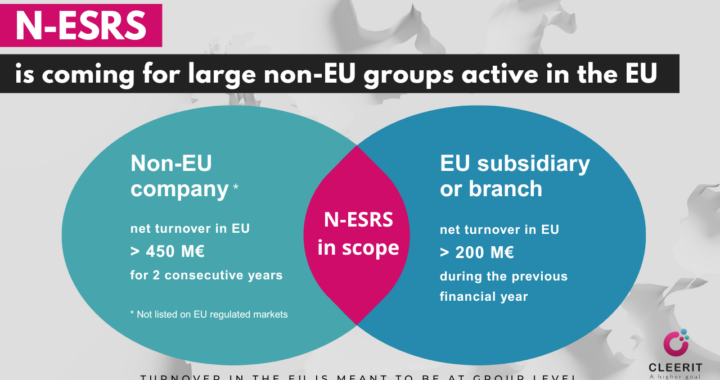
➡️ A non‑EU group must report under CSRD if it

  • generates more than €450 million in net turnover within the EU (for each of the two consecutive financial years) AND has,
  • EITHER an EU subsidiary generating more than €200 million in net turnover (or large undertaking),
  • OR an EU branch generating more than €200 million in net turnover

➡️ That EU entity must publish the parent’s sustainability report in the EU

➡️ The non-EU reporting obligations apply for FY 2028 (report published in 2029)

➡️ This report is impact‑focused, not full double materiality.

➡️ A specific reporting standard (N-ESRS) will be adopted for non-EU groups by 30 June 2026.

Read more in the article below 👇

Three categories of CSRD in-scope companies must publish a sustainability statement. Each category follows different rules and timelines.

1) EU undertakings (individual reporting) — Article 19a

An EU company must publish a sustainability statement at individual level if it meets these two thresholds:

  • Net turnover > €450 million (for each of the two consecutive financial years), and
  • More than 1,000 employees (average during the financial year)

This applies to large EU companies and credit institutions and insurance undertakings (same thresholds apply).

2) EU parent companies (consolidated reporting) — Article 29a

An EU parent company must publish a consolidated sustainability statement if the group, at consolidated level, if it meets these two thresholds:

  • Net turnover > €450 million (for each of the two consecutive financial years), and
  • More than 1,000 employees (average during the financial year)

Exception:  Financial holding companies that do not intervene in the management of their subsidiaries and whose subsidiary undertakings’ business models and operations are independent of one another, may opt out of consolidated sustainability reporting.

3) Non‑EU (third‑country) undertakings — Article 40a

A non‑EU parent company with significant presence in the EU must publish its parent sustainability statement in the EU (via its EU subsidiary or branch) if:

  • The non‑EU group generates more than €450 million turnover in the EU AND it has
  • either an EU subsidiary with more than €200 million turnover or classified as large,
  • or an EU branch with more €200 million turnover

4) What must third‑country undertakings report?

They must publish a sustainability report at the global consolidated level of the non‑EU parent company.

The report must follow one of these frameworks:

  1. ESRS, or
  2. Standards deemed “equivalent” by the European Commission, or
  3. Specific reporting standards (N-ESRS) that the Commission will adopt through delegated acts for non‑EU groups by 30 June 2026.

Specifically, N-ESRS will specify the information that an undertaking shall disclose about its material impacts in relation to environmental, social, and governance sustainability topics.

This non-EU special standard focuses on “impact‑related information” only — not on financial risks or opportunities. This is a deliberate political and legal choice:

  • The CSRD legally limits their reporting scope.
  • The EU cannot impose full double materiality on non‑EU parents.
  • Impact reporting fills the gap left by ISSB/IFRS-S.
  • It avoids excessive burden and jurisdictional conflict.
  • It ensures minimum transparency for EU markets.

The report must be:

  • Published in the EU,
  • Digitally tagged,
  • Freely accessible,
  • Prepared in a single electronic reporting format.

5) Role of the EU subsidiary or branch

The EU subsidiary or branch is responsible for:

  • Publishing the parent company’s sustainability report in the EU,
  • Ensuring it is accessible to the public.

6) Assurance requirements

The report must undergo limited assurance.

7) Timeline

The obligations for third‑country undertakings apply later than for EU companies, with reporting expected to begin 2029 for financial year 2028.

8) Purpose of the rules

  • Ensure level playing field between EU and non‑EU companies.
  • Provide investors with comparable sustainability data.
  • Prevent regulatory arbitrage by large non‑EU groups operating in the EU.

9) When Can an EU Subsidiary Be Exempt from Sustainability Reporting?

Article 19a(9) of the CSRD also sets out when an EU subsidiary can be exempt from preparing its own sustainability statement.

In short: a subsidiary doesn’t need to report separately if it is fully covered by its parent company’s consolidated sustainability report.

When the exemption applies

An EU subsidiary can rely on the parent company’s reporting if:

  • The parent (EU or non‑EU) publishes a consolidated sustainability report that includes the subsidiary.
  • That consolidated report follows EU sustainability reporting standards (ESRS) or is deemed equivalent to them.
Conditions the subsidiary must meet

To use the exemption, the subsidiary must include in its own management report:

  • The name and registered office of the parent company.
  • Weblinks to the parent’s consolidated sustainability report and its assurance opinion.
  • A clear statement that the subsidiary is exempt from preparing its own sustainability report.
Additional rules for non‑EU parent companies

If the parent is outside the EU:

  • Its consolidated sustainability report and assurance opinion must be published in line with EU rules.
  • The subsidiary must still disclose the EU Taxonomy Article 8 indicators for its own EU activities, either in its own management report or within the parent’s consolidated report.
  • Why this matters: Article 8 of the EU Taxonomy requires companies to disclose KPIs such as: Taxonomy‑eligible and aligned turnover, CapEx and OpEx. These KPIs must still be visible for the EU‑based activities, even if the parent handles the rest of the sustainability reporting.
  • In other words: Even when a non‑EU parent covers the group’s sustainability reporting, the EU subsidiary cannot “disappear” from the EU Taxonomy. Its EU activities must remain transparent and compliant.
Language requirements

Member States may require the parent’s consolidated report to be published in a locally accepted language, with translation if needed.

10) Do Joint Ventures count in the employee CSRD thresholds?

Under Directive 2013/34/EU, a joint venture is not treated as a subsidiary (full control) but as an undertaking under joint control, typically accounted for using:

  • the equity method in consolidated accounts, or
  • cost or equity method in individual accounts.

In both cases, employee numbers of the joint venture are not added to the parent’s employee count.

The directive only requires including employees of subsidiaries in consolidated thresholds.

Article 3(5)–(7) specifies that groups calculate thresholds on a consolidated basis, which includes only parent + subsidiaries:

“groups shall be groups consisting of parent and subsidiary undertakings to be included in a consolidation and which, on a consolidated basis, exceed the limits of …”

Sources:

[CSRD] Directive (EU) 2022/2464: https://eur-lex.europa.eu/legal-content/EN/TXT/?uri=CELEX:32022L2464

[Accounting Directive ] Directive 2013/34/EU: https://eur-lex.europa.eu/legal-content/EN/TXT/?uri=CELEX%3A02013L0034-20240528

[Omnibus I] Directive (EU) 2026/470 of the European Parliament and of the Council of 24 February 2026 amending Directives 2006/43/EC, 2013/34/EU, (EU) 2022/2464 and (EU) 2024/1760 as regards certain corporate sustainability reporting requirements and certain corporate sustainability due diligence requirements: https://eur-lex.europa.eu/legal-content/EN/TXT/?uri=OJ:L_202600470

More about EFRAG’s draft N-ESRS project: https://www.efrag.org/en/projects/noneu-groups-standard-setting/research-phase

Summary of opinions on draft simplified ESRS: ECB, EBA, ESMA, EIOPA

🔎 What the financial and supervisory authorities expect from the revised ESRS

When the European Commission adopts the delegated acts on the ESRS, it must consider EFRAG’s draft (December 2025) and request the opinions of a wide range of EU bodies — including ESMA, EBA, EIOPA, the ECB, the European Environment Agency, the EU Agency for Fundamental Rights (FRA), the Committee of European Auditing Oversight Bodies and the Platform on Sustainable Finance.

Below is a short overview of the ECB, EBA, ESMA and EIOPA opinions — all of which shed light on the sustainability information that financial markets need, and the expectations placed on companies, banks and insurers.

You can download a more comprehensive summary here: Summary of ECB, EBA, ESMA and EIOPA opinions on simplified ESRS 05-03-2026

🔹 Digitisation and usability

ESMA emphasises that effective digital tagging is essential for the usability of sustainability information. Users must be able to identify and retrieve key data efficiently.

🔹 Concerns about cumulative reliefs

All authorities highlight that the accumulation of relief measures risks undermining the CSRD’s objective: creating a reliable, standardised data ecosystem that enables benchmarking, risk differentiation and comparability.

🔹 Permanent reliefs and distorted incentives

They warn that several permanent reliefs could create incentives for undertakings to omit relevant information or delay efforts to improve methodologies and data access. This would weaken the integrity and comparability of disclosures — and increase greenwashing risks.

🔹 Competitiveness and alignment with ISSB

In many areas, the new ESRS reliefs go beyond those in the IFRS ISSB standards, with potential negative consequences for EU companies’ competitiveness and access to global financial markets.

🔹 Reliefs must remain exceptional

The ECB recognises that companies may need initial flexibility while building data systems and estimation methods. But it stresses that reliefs must remain exceptional, not become the norm.

🔹 Progressive capability‑building

For the EBA, once impacts, risks and opportunities (IROs) are identified, undertakings should progressively equip themselves to provide the required ESRS information.

🔹 Avoiding long‑term data gaps

All authorities agree: it is essential to avoid indefinite data gaps and to maintain incentives for companies to start collecting data and improving coverage and quality.

🔹 Assurance implications

ESMA notes that permanent reliefs will require additional judgement from assurance providers and more documentation from preparers — potentially increasing the reporting burden.

👥 FRA’s perspective

In addition, the EU Agency for Fundamental Rights (FRA) issued an opinion focused on safeguards for people adversely affected by corporate activities. FRA warns that several changes may make severe or systemic human rights impacts less visible — especially those occurring deep in value chains or affecting marginalised groups.

FRA’s full opinion is particularly relevant for HR, sustainability and compliance professionals: https://fra.europa.eu/en/news/2026/fra-issues-legal-opinion-proposed-simplified-european-sustainability-reporting-standards

Link to the Omnibus I directive: Directive – EU – 2026/470 – EN – EUR-Lex

European Union Agency for Fundamental Rights opinion on draft simplified ESRS

While ECB, EBA, ESMA and EIOPA focus in particular on cross-cutting and environmental standards, the European Union Agency for Fundamental Rights (FRA) opinion assesses whether the proposed simplifications of ESRS preserve essential safeguards for people adversely affected by corporate activities, and do not compromise the protection of human rights or the quality of disclosures.

FRA applies a risk-based human rights approach, grounded in the UN Guiding Principles on Business and Human Rights and the OECD Guidelines for Multinational Enterprises.

FRA’s full opinion is particularly relevant for HR and compliance professionals: https://fra.europa.eu/en/news/2026/fra-issues-legal-opinion-proposed-simplified-european-sustainability-reporting-standards

Here’s a short summary :

What changed / Why it matters for fundamental rights

  • The recent simplification of the ESRS aimed to ease the reporting burden on companies, particularly smaller entities, while seeking to retain the essential safeguards that underpin effective sustainability disclosure.
  • The sustained focus on a human rights risk-based framework aligned with the approach articulated in the UNGPs is welcome for its potential to enhance focus and practicality.
  • However, a more streamlined regime also carries risks, including the possibility of inconsistent application or reduced transparency where companies interpret materiality too narrowly.
  • The draft simplified ESRS introduce extensive reductions in mandatory data points, broaden the reliance on reliefs and phase ins, and increase the use of estimates and proxies in value chain reporting.
  • Social metric reductions affect gender equality, non-employee transparency, work life balance, and occupational health and safety, while climate and pollution disclosures have become less prescriptive.
  • These changes matter because they may render making severe or systemic human rights impacts less visible, particularly where they occur deep in value chains or affect marginalised groups.
  • Moreover, simplifications in climate and pollution reporting may slow the detection of harms affecting fundamental rights to health, decent work, and a safe environment.

FRA are also apposed to relocating human rights policy disclosures to a single, cross-cutting item ( GDR-P), since it risks reducing human rights to generic statements. The GDR-P disclosures should require to remain explicitly disaggregated by rightsholder group (own workforce, value chain workers, affected communities and consumers), setting out group-specific commitments and the associated governance and due diligence approaches, rather than a single, undifferentiated policy statement.

In addition, FRA identifies three clusters of changes that could significantly weaken transparency on gender outcomes:

1️⃣ Gender pay gap (S1‑15)

The simplified ESRS would require companies to disclose only the unadjusted gender pay gap — a single aggregate figure showing the raw difference in average pay between men and women.

No adjusted analysis.

No breakdown by age, category, or country.

This falls short of both GRI and the Pay Transparency Directive, which requires deeper analysis and action when unexplained gaps exceed 5%.

Without granularity, companies may appear compliant while lacking the insight needed to detect discrimination or structural bias.

2️⃣ Removal of gender‑disaggregated data

Several mandatory gender breakdowns disappear in the simplified standards, including:

▪️ non‑guaranteed‑hours employees (S1‑5)

▪️ participation in performance and career development reviews, and average training hours (S1‑12)

▪️ uptake of family‑related leave (S1‑14)

These deletions reduce visibility into gender‑specific outcomes — especially for women in precarious roles or with limited access to development opportunities.

They also diverge from GRI requirements and weaken the ability to identify structural barriers.

3️⃣ From “parental leave” to “maternity leave” (S1‑10)

Replacing parental leave with maternity leave narrows the scope of social protection disclosures.

EU law — notably Directive (EU) 2019/1158 — promotes shared caregiving, granting each parent at least four months of parental leave.

By focusing only on maternity leave, the simplified ESRS risk reinforcing the stereotype that childcare is primarily a women’s responsibility, sidelining fathers and undermining gender equality objectives.

🔍 Why this matters

Taken together, these revisions reduce the ESRS’ ability to reveal gender disparities.

Without mandatory gender‑disaggregated data, companies will struggle to identify patterns such as:

▪️ women’s over‑representation in variable‑hour or part‑time roles,

▪️ unequal access to training and career development,

▪️ structural barriers affecting women differently across operations and value chains.

Intersectional inequalities — increasingly recognised in EU policy — also become harder to detect when disclosures are limited to aggregate figures.

💬 Final thought

Transparency is not a burden; it is a prerequisite for progress.

If we want to close gender gaps, our reporting standards must illuminate inequalities — not obscure them.

Let’s keep pushing for the data and the standards that make equality real.

European Central Bank (ECB) opinion on draft simplified ESRS

The European Central Bank (ECB) has published its opinion on the draft simplified ESRS. As a long‑standing supporter of the EU’s sustainability reporting framework, it welcomes the simplification achieved, calling it “a good starting point” as reporting practices mature.

ECB focused on the standards most relevant to the ECB’s mandate: ESRS 1, ESRS 2, E1 (Climate Change) and E4 (Biodiversity and Ecosystems), essential for identifying, assessing and managing financial risks stemming from climate‑ and nature‑related physical and transition factors.

Over 90% of ECB‑supervised banks have identified these factors as material sources of financial risk.

Banks depend on reliable sustainability data to assess creditworthiness, price products and evaluate collateral.

The ECB stresses that the revised ESRS must ensure transparency, high‑quality information and comparability to support sound risk management, financial stability and effective capital allocation.

Reliefs, phase‑ins and exemptions

A key challenge is balancing simplification with the EU’s CSRD objectives.
The ECB warns that the permanent reliefs, phase‑ins and exemptions — many going beyond IFRS/ISSB — risk creating data gaps, reducing comparability and weakening interoperability with international standards.

This could undermine investor confidence and place EU companies at a competitive disadvantage globally.

The ECB recommends time‑limiting reliefs and removing the additional 3‑year phase‑in for anticipated financial effects (AFEs), which would delay the data until 2030.

ECB also notes that, following Omnibus I, the revised ESRS will apply only to Europe’s largest companies, which generally have the resources to meet these requirements.

Assurance standards

ECB staff stress the importance of swiftly adopting assurance standards, as these will be essential for improving the quality and comparability of disclosures under the revised ESRS.

VSME

ECB staff highlight concerns about using the VSME as the voluntary standard for companies outside the CSRD scope.

The VSME was designed for non‑listed SME companies with fewer than 250 employees, whose sustainability risks and complexity differ significantly from larger companies (with up to €450m turnover and/or 1 000 employees).

👉 The revised ESRS are a more suitable voluntary option, as they can flexibly accommodate companies of different sizes and complexities thanks to their materiality‑driven approach, and the ESRS are now more streamlined in terms of datapoints.

While ECB staff support voluntary reporting under the revised ESRS, they stress the need for guidance and safeguards to limit greenwashing risks.

Voluntary use must not allow cherry‑picking, which could enable companies to disclose only favorable information while obscuring material negative impacts or risks.

Additional information for the financial sector

For credit institutions, most ESG risks, impacts and opportunities are concentrated in the downstream part of the value chain, as they are related to the activities of the clients that they fund.

ECB recommend the addition of guardrails so that the new DMA value chain flexibilities do not lead to the non-identification of material IROs which would ultimately compromise a fair presentation and lead to financial risks not being disclosed and managed by banks.

Regarding greenhouse gas emission reduction targets under ESRS E1-6: complementing the disclosure of a GHG intensity target with information on the associated absolute figure as per ESRS Set 1 is necessary to achieve a fair presentation, to enable a better understanding of the target and to avoid misleading users (given that intensity targets might show a decrease whereas in fact absolute emissions are expected to increase).

Exempting the financial sector from providing transparency on their emissions reduction commitments could give rise to systemic greenwashing risk and create opacity, possibly resulting in an underestimation of risks by investors and the misallocation of funds.


The link to full opinion: https://www.ecb.europa.eu/pub/pdf/other/ecb.staffopinion_europeansustainabilityreportingstandards202602.en.pdf

Simplified ESRS: the IRO-PATM logic

In simplified ESRS IRO management has taken center stage

On October 1st ESMA wrote that “the objective of the sustainability statement is not to report on a sustainability topic related to material IROs, but rather to provide material information on the material IROs which pertain to different topical areas”.

And that the “logic of the overarching structure of the ESRS” is “the description of the IROs and of how they are managed through policies, actions and targets”.

From EFRAG’s basis for conclusions we learn that:

⭕ The connectivity between IROs and PATs has been clarified and emphasized

The objective of the sustainability statement, taken as whole, is to present fairly all the business’s sustainability-related material impacts, risks and opportunities (IROs) and how the business manages them through policies, actions, targets and metrics (PATMs), and thereby manages (or not) the related material sustainability topics.

The embedded logic of the ESRS therefore calls for identification of material IROs and disclosure of PATMs – or their absence – for the related sustainability topic.

Companies can now use a tabular format for presenting the material IROs and PATs and also specify the list of material topics for which there are no PATs.

ESRS no longer require disclosure of reasons for not having PATs or plans and timeline to implement them.

The text now also clarifies that the description of material IROs may be presented alongside information on PATM.

Value chain information presented in SBM-1 remains essential for understanding and linking IROs within a sustainability statement.

⭕ General Disclosure Requirements (GDR) for PATs

The overlaps that existed between MDRs (now GDRs) for PATs on the one hand, and topical mandatory datapoints, on the other, have been addressed with the following:

  • “Minimum” Disclosure Requirements (MDR) have been renamed “General” Disclosure Requirements (GDR), reflecting the fact that they are the reference point for the required information to be disclosed for PATs across all topical Standards.
  • There are no (or very limited) other PAT datapoints in the topical Standards.

⭕ Level of aggregation disclosures related to IRO management

ESRS now clarifies the possibility to disclose PATM information at different levels of aggregation, reflecting factors such as the nature of the IROs or the way the business manages them, as well as the level at which significant variations of material IROs arise.

A specification has been also added in case of adoption of PATs but only for certain aspects (of a topic).

⭕ AMF, the regulator of the French financial market, also wrote:

A common structural gap across policies, actions and targets (PAT) is their lack of explicit linkage to the material impacts, risks, and opportunities (IROs) identified through the materiality assessment.

While some companies articulate this alignment clearly, most disclosures remain siloed, preventing readers from understanding how corporate responses are tailored to material sustainability topics.

Embedding this IRO-to-response logic systematically across disclosures would enhance narrative coherence, reduce duplication, and reinforce alignment with the ESRS architecture.

Sources:

https://www.efrag.org/sites/default/files/media/document/2025-12/Draft_Amended_ESRS_Basis_for_Conclusions_2025_December.pdf

https://www.esma.europa.eu/sites/default/files/2025-10/ESMA32-846262651-5289_ESRS_revision_ESMA_response_to_EFRAG_consultation.pdf (paragraph 35 and 77)

Page 56 in https://www.amf-france.org/sites/institutionnel/files/private/2025-10/amf_study_csrd_reporting_the_way_forward_2025.pdf

The European Parliament has approved the provisional CSRD & CSDDD Omnibus I agreement

On 16/12, the European Parliament approved the provisional Omnibus I agreement on reduced sustainability reporting and due diligence rules for companies.

The text was adopted with 428 votes in favour, 218 against and 17 abstentions.

The final text will have to be formally approved by Council, but approval is highly likely.

The directive will enter into force 20 days after its publication in the Official Journal. Member States will have 12 months to transpose the new rules.

The Corporate Sustainability Reporting Directive – CSRD – will apply for:

  • EU companies with over 1,000 employees and a net annual turnover of over €450 million,
  • as well as non-EU companies with net turnover in the EU of over €450 million and their subsidiaries and branches generating turnover higher than €200 million in the EU.

➡️Parent companies that are financial holdings (not directly or indirectly involved in the management of their subsidiaries) with subsidiaries having business models and operations independent from one another, may choose not to report according to CSRD.

This excludes cases where companies are closely interconnected through their business activities, for example when the activities of one subsidiary enable or directly support the activities of another subsidiary.

➡️ Member States may exempt 1st wave companies, that had to start reporting from FY 2024 but that now fall out of the new CSRD scope, from reporting on FY 2025 and 2026.

➡️ Companies with fewer than 1,000 employees will not have to provide information to their bigger business partners beyond what will be included in an upcoming delegated act on sustainability reporting standards for voluntary use.

This restriction does not affect information requests from companies for purposes other than their sustainability reporting as required by CSRD, including requests for the purpose of complying with Union requirements to conduct a due diligence process.

➡️Member States are required to ensure that statutory auditors and audit firms carry out the assurance of sustainability reporting in compliance with limited assurance standards to be adopted by the Commission.

According to the text, companies have raised concerns on the work carried out by the assurance providers. To allow adequate time to develop the standard the deadline for its adoption is therefore postponed to 1 July 2027.

➡️ A review clause has been introduced concerning a possible extension of the CSRD’s scope if needed to ensure the Union’s objective of enabling the disclosure of sufficient data on corporate sustainability to mobilise private investments towards EU Green Deal.

Sources:

https://www.europarl.europa.eu/news/en/press-room/20251211IPR32164/simplified-sustainability-reporting-and-due-diligence-rules-for-businesses

https://data.consilium.europa.eu/doc/document/ST-16702-2025-INIT/en/pdf