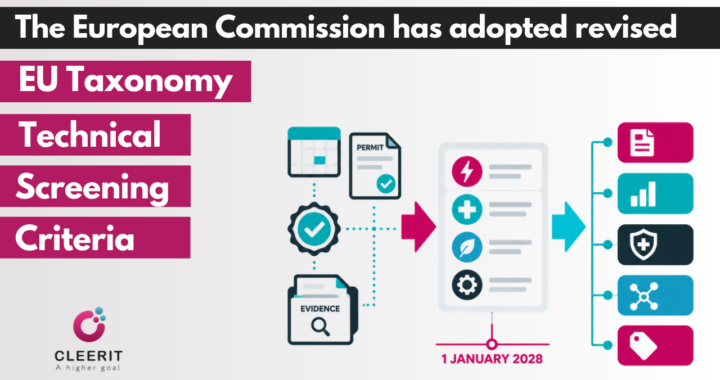
The EU is taking steps to make the Green Taxonomy more workable in practice, without lowering its environmental ambition.
Following the European Commission’s adoption of revised Technical Screening Criteria (26 November 2026) and ESMA’s technical advice on reporting simplification (29 October 2026), sustainability and finance teams face two major developments:
What is changing now (Adopted by the Commission):
- Simpler compliance & evidence: Greater reliance on existing EU laws (like REACH and the EIA Directive), valid environmental permits, and third-party certifications to prove alignment.
- Activity-level updates: Targeted revisions across key sectors (including energy, manufacturing, batteries, transport, and construction) – meaning prior assessments cannot simply be carried over unchanged.
- Transition timeline: Mandatory from 1 January 2028, with an option to continue using previous criteria for FY2027 (or adopt early where advantageous).
What may be coming next (Proposed by ESMA):
- Narrower OpEx KPI: A recommendation to limit mandatory OpEx reporting to non-capitalised R&D (with a broader exception retained for EU Green Bond issuers).
- Streamlined group reporting: Removing the complex weighted-average KPI for mixed groups in favour of the parent company’s main reporting regime.
- ESRS integration & digital tagging: Allowing cross-referencing to ESRS disclosures to avoid duplication, alongside a closed list of contextual datapoints to support future digital Taxonomy tagging and machine readability.
The bottom line for preparers:
Don’t rebuild your Taxonomy process from scratch. Focus on mapping your existing regulatory permits and evidence to the revised technical criteria, check for sector-specific shifts, and treat ESRS as the structured digital backbone for your sustainability data.
With roughly half of in-scope companies still relying on Excel for sustainability reporting, these reforms are a clear signal to review your system support for ESRS and Article 8. Moving from disconnected spreadsheets to a governed, audit-ready reporting system is essential to handle digital tagging, version-controlled criteria, and cross-referenced disclosures.
EU Taxonomy: revised technical screening criteria adopted
On 26 November 2026, the European Commission adopted amendments to both the EU Taxonomy Climate Delegated Act and Environmental Delegated Act, underpinning the EU classification system for sustainable economic activities.
The revised criteria apply from 1 January 2028, while companies may continue applying the previous criteria for financial years beginning in 2027.
The objective is to make the technical screening criteria easier to understand, apply and evidence, while maintaining the Taxonomy’s environmental integrity and ambition.
The changes are particularly important for companies assessing Taxonomy alignment. They affect activity descriptions, substantial-contribution criteria and Do No Significant Harm (DNSH) criteria across a wide range of sectors.
The practical direction is clear: less duplication, greater reliance on existing EU legislation and existing evidence, and clearer ways for companies to demonstrate that the criteria are met.
-
The Taxonomy is being simplified, not fundamentally redesigned
The Commission explicitly says that the review is not intended to revisit the policy choices underpinning the Taxonomy Regulation. Instead, it targets criteria that experience has shown to be overly complex, duplicative or difficult to apply consistently.
The fundamental architecture therefore remains: companies still determine whether an activity is Taxonomy-eligible and, for alignment, whether the applicable requirements for substantial contribution and DNSH are met.
-
Demonstrating alignment should become easier
The Commission identified a recurring problem: companies were sometimes reporting lower levels of Taxonomy alignment because they could not obtain the documentation needed to prove compliance with every technical criterion, even where they had taken significant steps towards alignment.
The revised criteria therefore provide clearer and, in several areas, more practical ways of demonstrating compliance.
For example:
- existing environmental permits can in certain circumstances be used to demonstrate compliance with water-related and other environmental requirements;
- Environmental Impact Assessments are required in the revised biodiversity DNSH criteria only where the activity is already subject to the EIA Directive;
- existing regulatory documentation, including valid permits, can support demonstration of compliance with certain industrial-emissions requirements;
- independent third-party certification can serve as supporting evidence for certain conservation and restoration activities; and
- several DNSH requirements are more directly aligned with existing EU legislation.
Review your current Taxonomy evidence library. Map permits, EIAs, certifications and other existing regulatory documentation against the revised criteria before creating new evidence specifically for Taxonomy purposes.
-
DNSH criteria are becoming more closely aligned with existing EU law
A substantial part of the simplification concerns Do No Significant Harm.
The revised acts seek to reduce situations where Taxonomy creates additional or divergent requirements on top of existing environmental regulation. This is particularly visible in criteria concerning chemicals, water, biodiversity, climate adaptation and industrial emissions.
For chemicals, for example, the criteria are brought closer to REACH and other EU chemicals, products and waste legislation, while certain requirements are removed for activities such as transport and services where operators do not have adequate information about chemical use.
For climate adaptation, the generic DNSH criteria are restructured and clarified. For mobile assets such as transport activities, the climate-adaptation DNSH criterion is removed where a location-based climate-risk assessment would not be appropriate.
This means that you should not assess DNSH as an isolated Taxonomy exercise. Map the revised requirements to the company’s existing compliance processes under REACH, environmental permitting, water legislation, EIA requirements and other applicable EU environmental legislation.
-
Many activity-specific criteria are changing
This is not simply a horizontal clean-up of DNSH. The amendments reach into a large number of individual economic activities.
The Climate Delegated Act changes criteria affecting areas including: forestry and wetlands; manufacturing and low-carbon technologies; hydrogen and batteries; plastics; energy; transport by road, rail, water and air; construction and real estate; ICT; water, wastewater and waste; and research, development and innovation.
There are also some very specific changes. For example, life-cycle GHG calculations and the 100 gCO₂e/kWh threshold are removed for geothermal energy; criteria for manufacturing and recycling batteries are separated; criteria concerning fossil-fuel transport are narrowed to assets specifically designed for transporting or storing fossil fuels; and construction and renovation criteria are adjusted.
The Environmental Delegated Act also changes criteria across water, circular economy, pollution prevention and biodiversity. Among other things, it adjusts criteria for plastic packaging, electrical and electronic equipment, water and waste activities, construction, circular-economy services and conservation/restoration.
This means that you should not rely on last year’s Taxonomy assessment unchanged.
Create a change map at activity level: Activity → existing criteria → revised criteria → evidence affected → change required
Prioritise activities representing significant Turnover or CapEx, as changes in alignment can directly affect the company’s reported Taxonomy KPIs.
-
Some activities may need to be reassessed, not simply updated
The changes are not uniformly “easier criteria.”
For example, the Environmental Delegated Act removes technical screening criteria for certain pharmaceutical activities because the Commission concluded that deleting problematic requirements would leave criteria that merely reflected ordinary industry practice and would therefore fail to meet the standard required for substantial contribution.
The Climate Delegated Act also changes activity boundaries, definitions and sector-specific requirements across manufacturing, energy and transport.
For each previously eligible or aligned activity, determine whether:
- the activity description has changed;
- the substantial-contribution criteria have changed;
- applicable DNSH criteria have changed; and
- existing evidence remains sufficient.
Do not assume that an activity classified as aligned under the current criteria will automatically remain aligned under the revised criteria.
-
Existing evidence becomes more valuable
There is a broader lesson behind many of these changes.
The Commission explicitly identifies assessing and proving compliance as a major implementation difficulty. The revised acts repeatedly seek to make evidence requirements clearer and allow greater use of documentation generated under other EU regulatory processes.
This makes evidence management an important part of Taxonomy preparation.
For each material Taxonomy activity, maintain the connection: economic activity → eligibility → applicable criteria → assessment → supporting evidence → alignment result → KPI
Rather than collecting documents at reporting time, establish ownership and traceability of evidence as part of the ongoing Taxonomy process.
-
Pay particular attention to the transition dates
Both adopted texts state that the amended Regulations apply from 1 January 2028.
They also expressly allow companies, for a financial year beginning between 1 January and 31 December 2027, to continue applying the previous criteria as applicable on 31 December 2027.
In practical terms:
Financial year 2027
Companies can choose not to apply the revised criteria and continue using the existing criteria.
This also means using 2027 as a transition and impact-assessment period.
If the revised criteria clearly simplify assessment or improve your ability to demonstrate alignment, assess whether adopting them for FY2027 is advantageous.
Financial year 2028 onwards
The revised criteria apply.
Before that, the adopted acts are subject to scrutiny by the European Parliament and Council and will enter into force following publication in the Official Journal, provided the scrutiny process is completed without objection.
For companies where the revised criteria clearly simplify assessment or improve the ability to demonstrate alignment, assess whether adopting them for FY2027 is advantageous.
-
What has not changed
The simplification should not be interpreted as a reduction in the Taxonomy’s environmental objectives.
The revised acts preserve the underlying Taxonomy framework and explicitly aim to improve usability without lowering environmental ambition. The Commission states that the revisions do not introduce significant changes affecting the overall ambition of the climate substantial-contribution criteria and do not significantly change key GHG thresholds for activities presenting a risk of high emissions.
Companies will still need to determine and substantiate whether activities meet the applicable Taxonomy criteria.
In short, the Taxonomy is becoming easier to apply, but evidence remains essential.
Key takeaway
Simpler criteria. Clearer evidence. Same underlying ambition.
The European Commission has revised the EU Taxonomy’s technical screening criteria to make them more workable in practice. The changes reduce duplication, align more requirements with existing EU legislation and clarify how companies can demonstrate compliance.
For preparers, the priority now is not to rebuild the Taxonomy process, but to identify which activities and criteria have changed, assess the impact on current alignment results, and map existing permits, certifications and other evidence to the revised requirements.
The revised criteria apply from 1 January 2028, while companies may continue applying the previous criteria for financial years beginning in 2027.
Sources:
Upcoming review of the EU Taxonomy reporting requirements
On 4 March 2026, the European Commission also formally asked the three European Supervisory Authorities to provide technical advice for its upcoming review of the Taxonomy reporting requirements.
This is a different part of the same simplification trajectory. The November Commission acts revise what companies need to meet and demonstrate for Taxonomy alignment.
The upcoming review points towards possible future simplification of how companies report that Taxonomy information under Article 8.
The direction is towards simpler, more usable Taxonomy reporting, with better consistency and interoperability across the EU sustainable finance framework, while preserving the transparency needed to direct finance towards sustainable activities and prevent greenwashing.
On 29 October 2026 ESMA published their Technical Advice on simplifying key performance indicators under the Taxonomy Disclosures Delegated Act to the European Commission.
They are ESMA recommendations to the European Commission, not yet new reporting rules. The Commission must now decide what to incorporate into its review of the Taxonomy Disclosures Delegated Act (DDA).
ESMA recommends narrowing the mandatory operating expenditure (OpEx) KPI to non-capitalised research and development expenditure. It also proposes simpler group Taxonomy reporting, including removing the weighted-average KPI, and targeted measures to make disclosures more proportionate, clearer and easier to use.
What may change
-
A much narrower OpEx KPI may be coming
The most significant proposal for non-financial companies is to restrict the mandatory OpEx KPI to non-capitalised R&D expenditure. The denominator would be based on R&D expenses recognised under IAS 38, or the applicable national GAAP, while the numerator would continue to reflect the relevant Taxonomy categories. Existing materiality reliefs would remain.
ESMA concluded that the current KPI creates significant collection and reconciliation work while providing relatively limited additional information compared with Turnover and CapEx.
How to prepare
- Do not change your current reporting methodology yet. The proposal is not applicable law.
- Identify which elements of your current OpEx denominator are non-capitalised R&D and where that information sits in your accounting system.
- Check how reliably R&D expenditure can be linked to Taxonomy economic activities and assessed for eligibility and alignment.
- Keep your existing OpEx data structure for now rather than deleting data or controls, since the Commission may modify ESMA’s proposal.
For companies issuing EU Green Bonds, note an important exception: ESMA proposes retaining a broader (though simplified) definition of eligible OpEx specifically for use-of-proceeds allocation under the European Green Bond Regulation (EuGB). Under this proposal, eligible operating expenditure would continue to cover specified categories beyond non-capitalised R&D (such as building renovation measures, short-term leases, and maintenance and repair expenditure) rather than being restricted solely to non-capitalised R&D.
-
Mixed groups could see a major simplification in group reporting
For mixed groups and financial conglomerates, the ESAs recommend removing the weighted-average KPI that combines KPIs from different types of businesses.
Instead, the group would generally report according to the main reporting regime applicable to the parent undertaking, subject to specific rules for financial conglomerates and financial holdings.
However, this does not mean ignoring other businesses. Material secondary businesses not adequately reflected by the main reporting regime would still require simplified Taxonomy information.
ESMA proposes that secondary-business disclosures could be omitted where their cumulative consolidated turnover is below 10% of group turnover, or in certain cases where they are already adequately captured or serve exclusively intragroup needs. For non-financial secondary businesses requiring disclosure, ESMA proposes limiting information to headline Turnover and CapEx eligibility and alignment KPIs.
If you are a mixed group:
- Map the type of business of the parent and identify the likely main reporting regime.
- Identify secondary businesses falling outside that regime.
- Calculate their cumulative consolidated turnover as a percentage of group turnover.
- Flag businesses approaching or exceeding the proposed 10% threshold.
- Preserve sufficient Taxonomy information for material secondary businesses, but avoid investing prematurely in new full subsidiary-level templates.
-
More flexibility could be introduced for changes, acquisitions and new reporters
ESMA recommends several useful reliefs. These include relief relating to acquisitions, an adapted treatment for disposals/divestments, certain omissions of sensitive information and, in exceptional circumstances, comparative information. Use of these reliefs would be optional and would have to be explained in the contextual Taxonomy information.
Two proposed transition mechanisms are particularly relevant:
- Changes to Taxonomy rules or technical screening criteria: companies could choose to apply amendments only from the second financial year following entry into force, continuing with the previous requirements during the intervening financial year.
- New Taxonomy activities and first-time reporters: companies could report eligibility only in the first financial year, with alignment required from the following year.
-
Taxonomy reporting could increasingly build on ESRS disclosures
ESMA recommends allowing companies to cross-reference information disclosed under ESRS and incorporate certain ESRS information by reference rather than repeat the same information in their Taxonomy disclosures.
This is more significant than simply reducing duplication. In practice, it reinforces ESRS as the central framework for sustainability information that is relevant across reporting requirements. Where information has already been properly disclosed under ESRS, companies could increasingly use that disclosure as the reference point for Taxonomy reporting instead of recreating the same information in a separate Taxonomy process.
This makes the quality, structure and traceability of ESRS information even more important. ESRS and Taxonomy should therefore not be managed as separate reporting exercises. Companies should build a common sustainability information base in which information can be used consistently across ESRS and Taxonomy requirements.
How to prepare
- Treat ESRS as the backbone of your sustainability reporting architecture, rather than building separate data and documentation processes for each regulation.
- Identify information used in both ESRS and Taxonomy reporting, such as transition-plan information and other contextual sustainability information.
- Establish one governed source of information, with common ownership, methodology and evidence, that can support multiple disclosure requirements.
- Strengthen traceability from source data and evidence to ESRS disclosures, as these disclosures may increasingly support other regulatory reporting requirements as well.
- Avoid creating parallel versions of the same sustainability information unless the Taxonomy requirements specifically require different information.
The direction is towards ESRS as the backbone of sustainability reporting, with Taxonomy reporting increasingly able to build on information already disclosed under ESRS.
-
The move towards digital reporting continues
Simplification does not mean moving away from structured digital reporting.
ESMA recommends creating a closed and clearly defined list of quantitative and qualitative contextual datapoints that could subsequently form the basis for digital Taxonomy tagging. The objective is greater consistency, comparability and machine readability.
How to prepare
- Continue structuring Taxonomy information at datapoint level rather than preparing it only as narrative/report-layout content.
- Maintain clear links between: source data → calculation → KPI → contextual disclosure → evidence. This will make future digital tagging and assurance considerably easier.
- Build adaptability into reporting systems.
- Keep methodologies, calculations, contextual information and evidence structured and version-controlled so that new DDA/TSC rules, transition periods and eligibility-only reliefs can be implemented without rebuilding the process.
Sources:
https://www.esma.europa.eu/press-news/esma-news/esma-proposes-simpler-eu-taxonomy-reporting