Why Companies Should Care
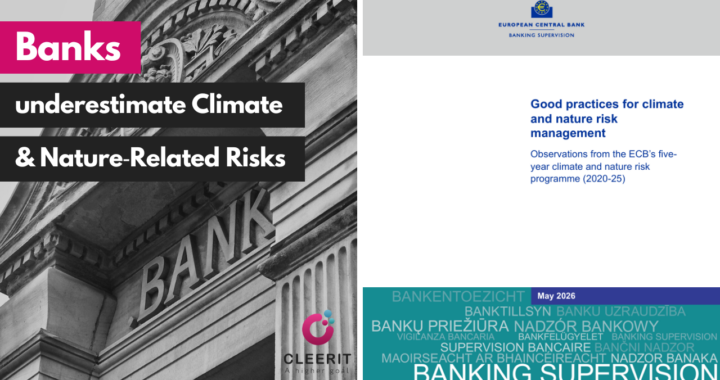
The European Central Bank has released its updated compendium of good practices on climate and nature‑related risk management – and the message is blunt: progress is real, but major blind spots remain.
Banks now have the basic frameworks in place, yet implementation is uneven. Many still fail to cover all material risk drivers, portfolios, and transmission channels.
🔎 Two areas stand out:
- Physical climate risks – methodologies are still immature, and the non‑linear, forward‑looking nature of these risks means they are likely underestimated.
- Nature‑related risks – most banks have run materiality assessments, but two‑thirds haven’t turned them into concrete actions. KRIs exist, but often without thresholds that trigger decisions. KRI = Key Risk Indicator measuring risk exposure.
Notably, one‑third of all new good practices focus on nature‑related risks – a clear signal of supervisory priorities.
⚠️ A risk landscape defined by uncertainty
The ECB warns that Europe is moving toward a disorderly transition, with faster‑moving physical and transition risks. Banks must prepare for a wider range of plausible futures, supported by more granular scenario analysis and stress testing.
🛡️ The insurance protection gap is widening
With insurance coverage shrinking and public finances strained, more climate‑ and nature‑related losses will fall directly on banks’ balance sheets – increasing scrutiny on exposed sectors and borrowers.
🌿 What this means for companies
This is not just a banking issue. It directly affects corporates seeking financing or refinancing.
- Expect more granular asset‑level data requests on Physical risk exposure, Transition plans, Nature‑related dependencies and impacts and Adaptation measures
- Weak disclosures = higher financing costs. If banks cannot quantify your risks, they will price in uncertainty.
- Nature‑related risks enter mainstream credit analysis. Expect more questions on biodiversity, land use, water dependency, and supply‑chain exposure.
- Transition plans must be credible and operational. Banks are moving from “statements” to evidence of execution. Companies without costed, time‑bound plans will face tighter covenants and reduced credit appetite.
- Scenario analysis becomes a shared language. Companies able to articulate resilience under disorderly transition scenarios will stand out.
The ECB’s message is clear: Climate and nature‑related risks are rising, complex, and still underestimated. Banks must accelerate – and so must companies.
Those who provide granular data, credible transition plans, and transparent nature‑related disclosures will secure better financing conditions and stronger long‑term resilience.
📘 The best way to prepare? Adopt ESRS.
The ECB’s expectations align closely with the European Sustainability Reporting Standards (ESRS). For companies, learning and adopting ESRS is the fastest, most reliable way to meet banks’ rising data needs.
👉 Contact us if you want to use our guided digital ESRS end-to-end templates to get a head start.