For companies reporting under ESRS, producing the sustainability statement is only one part of the exercise. The information must also be traceable, supportable and capable of withstanding independent assurance.
On 12 November 2026, the European Commission launched a targeted consultation on the future EU standard for limited assurance of sustainability reporting. Based on technical advice from CEAOB, the future standard is intended to establish a common approach to sustainability assurance across the EU. The consultation remains open until 18 January 2027.
Although the standard is not yet final, its direction already provides useful lessons for companies preparing ESRS statements.
Limited assurance does not mean checking only part of the sustainability statement.
A common misunderstanding is that “limited assurance” means that only selected sustainability indicators or disclosures are verified.
That is not the proposed approach. Limited assurance describes the level of assurance obtained by the practitioner, not a limitation on the sustainability information falling within the engagement.
Assurance will also involve more than checking whether required ESRS disclosures are present. The proposed EU approach requires the practitioner to consider the sustainability information as a whole, including its overall presentation, structure and content and whether it achieves fair presentation.
For companies, the practical message is important:
Preparing for assurance should be built into the ESRS reporting process, not added once the sustainability statement has been completed.
Your double materiality assessment needs an audit trail
The double materiality assessment (DMA) is not simply the preliminary exercise used to determine what goes into the sustainability statement. The process itself falls within the proposed ESRS assurance conclusion.
That means companies need to be able to demonstrate how they arrived at their materiality conclusions.
An assurance-ready DMA should leave a traceable record of:
- how impacts, risks and opportunities (IROs) were identified;
- which activities, business relationships and parts of the value chain were considered;
- which sources and stakeholder input were used;
- which methodologies, criteria and thresholds were applied;
- why IROs were considered material or non-material; and
- how the conclusions were reviewed and approved.
The important shift is from being able to explain the company’s DMA methodology to being able to produce evidence showing how it was actually applied.
Build traceability from the IRO to the reported information
The revised ESRS provides a useful foundation for assurance because it connects material IROs with the company’s management response through policies, actions, targets and metrics.
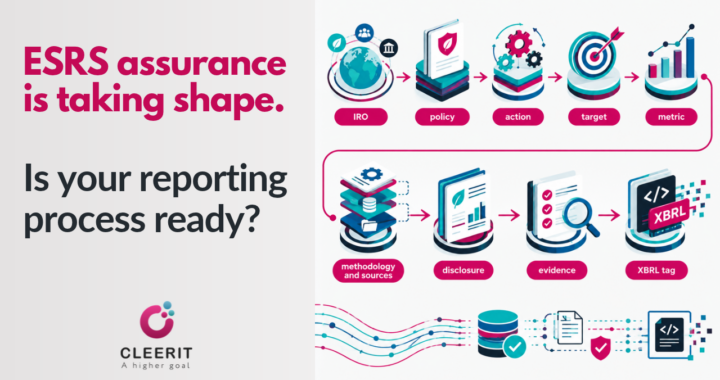
Companies should be able to follow a clear chain:
Material IRO → reporting requirement → policy → action → target → metric → methodology and sources → reported information → supporting evidence
The same chain should work backwards when an assurance provider selects a disclosure or metric for testing.
GDR-M already provides much of the foundation for metrics assurance
The revised General Disclosure Requirement for metrics, GDR-M, effectively asks companies to document the “story behind the number.”
For each relevant metric, companies must provide information including:
- the metric and unit of measurement;
- the calculation methodology;
- sources and input parameters;
- estimation methodologies, where relevant;
- significant assumptions and limitations;
- reliance on indirect data or proxies for value-chain metrics;
- planned measures to improve the quality of such data;
- relevant contextual information; and
- significant changes in performance and progress towards targets.
These are precisely the types of information that allow a reported metric to be understood, challenged and traced back to its underlying basis.
Good GDR-M implementation should therefore not be regarded simply as a disclosure exercise. It can provide the structure for an assurance-ready metric file documenting the methodology, source data, calculations, estimates, assumptions, limitations and significant year-on-year movements.
The assurance perspective then adds another question:
Can the company substantiate what it has disclosed?
For example:
- Can the source data be produced?
- Can the calculation be reproduced?
- Are significant assumptions and estimates documented and supported?
- Can indirect data and proxies be identified?
- Can significant changes from the previous year be explained?
- Is there evidence that the information was reviewed and approved?
Put simply:
GDR-M tells the company what needs to be understood about a metric. Assurance requires the company to be able to substantiate it.
Data provenance and internal controls matter
A sustainability platform or spreadsheet containing the final disclosure does not in itself constitute the complete evidence behind that disclosure.
For significant sustainability information, and particularly information involving estimates, methodological judgement or complex data flows, companies should be able to answer:
Who owns it? → Where did it come from? → How was it prepared or calculated? → What assumptions or estimates were used? → What controls were performed? → Who reviewed it? → What evidence supports the published information?
Companies should therefore retain source documents, methodologies, evidence supporting significant assumptions, control documentation and approval records as part of the ESRS reporting process.
This is particularly relevant for information produced internally and for data involving estimates or value-chain information. Swedish RevR 19, for example, explicitly emphasises professional scepticism concerning the relevance and reliability of information obtained during the assurance engagement, including internally generated information.
Do not forget the overall picture
Even a technically complete sustainability statement can present assurance difficulties if, taken as a whole, it gives an incomplete or misleading picture.
Companies should therefore add a fair-presentation review to the end of their reporting process.
This goes beyond asking: have we included all of the required disclosures?
It also asks: does the sustainability statement, taken as a whole, fairly represent our material impacts, risks and opportunities and how we manage them?
That means considering omissions, balance, clarity and consistency, as well as whether the emphasis given to different information appropriately reflects the company’s material sustainability matters.
This overall perspective is reflected in the emerging EU approach and is also evident in the existing Swedish assurance approach.
EU Taxonomy remains a specific assurance area
EU Taxonomy information should not be treated as a stand-alone table prepared at the end of the reporting process.
The proposed EU approach contemplates assurance procedures relating to eligibility and alignment, technical criteria, calculations, consistency with other sustainability information and, where appropriate, reconciliation with financial-statement information.
For companies, the practical implication is straightforward: Taxonomy KPIs should be supported by traceable calculations, documented assessments and underlying evidence.
Digital tagging is part of the reporting, not just an IT requirement
ESRS reporting is designed not only to be read but also to be digitally consumed.
XBRL tagging transforms the sustainability disclosures into structured, machine-readable information that can be extracted, analysed and compared digitally.
This also makes digital tagging relevant to assurance. CEAOB’s proposed approach includes understanding the company’s process and controls for preparing digitally marked-up sustainability information and assessing risks concerning the completeness, accuracy and machine readability of that information.
Companies should therefore not regard XBRL as simply a technical conversion performed after the sustainability statement is complete. They need processes and controls to ensure that:
- required information is tagged completely;
- the selected tags correctly represent the underlying disclosures;
- values and their digital representations remain consistent;
- the structure and relationships within the reported information are appropriately represented; and
- the final digital information is machine-readable.
The assurance question is therefore not only whether the sustainability information is correct, but also whether its digital representation faithfully carries that information to its users.
Is this a major change from current French and Swedish assurance approaches?
Not fundamentally.
France’s H2A guidance and Sweden’s RevR 19 are transitional approaches developed while the common European assurance framework is being established. The emerging EU framework therefore represents harmonisation and evolution rather than an entirely new assurance philosophy.
There are differences in the technical foundations. RevR 19 draws primarily on ISAE 3000, whereas CEAOB’s proposed European approach uses ISSA 5000 as its basis, adapted to the EU legal framework and supplemented for matters including ESRS, the EU Taxonomy and digital reporting.
For companies already preparing their reporting with assurance in mind, however, the fundamental direction should be familiar.
What should ESRS-reporting companies do to prepare?
There is no need to wait for the final EU assurance standard to improve assurance readiness. Most of the necessary actions are also simply good ESRS reporting practice.
We recommend to focus on eight areas:
- Build an audit trail into the DMA.
Retain the evidence, sources, methodologies, judgements, thresholds and approvals behind materiality decisions. - Establish traceability from IRO to PATM disclosure.
Make it possible to move from a material IRO to the resulting policy, action, target, metric and disclosure, and back again. - Use GDR-M and GDR-T as assurance foundations.
Document methodologies, sources, calculation methods, estimates, assumptions, limitations and relevant contextual information as part of preparing the disclosure, not afterwards. - Assign evidence ownership.
Significant disclosures and metrics should have identifiable owners, sources and supporting documentation. - Strengthen sustainability-data controls.
Define responsibilities for preparation, wording, calculation, review, changes and approval. - Connect sustainability and financial information.
Ensure consistency and reconciliation where sustainability disclosures, financial effects, resources or EU Taxonomy KPIs rely on financial information. - Finish with a fair-presentation review.
Assess whether the sustainability statement as a whole gives a balanced, understandable and non-misleading picture of the company’s material sustainability topics and IROs. - Prepare for digital reporting.
Structure sustainability information at datapoint level and establish responsibilities and controls over XBRL tagging so that the machine-readable information is complete, accurate and consistent with the sustainability statement.
How Cleerit ESG supports assurance-ready and digitally consumable ESRS reporting
These requirements point towards an ESRS reporting process built around structured datapoint level information, traceability and evidence rather than disconnected spreadsheets and reporting templates.
This is the architecture behind Cleerit ESG. Cleerit connects the DMA and material IROs with policies, actions, targets and metrics and links these elements to the relevant ESRS requirements and datapoints. The result is a traceable path from:
Material IRO → management response → GDR-P/A/T/M → ESRS disclosure → supporting information
For digital reporting, Cleerit structures ESRS information at datapoint level, with the relevant ESRS paragraph and XBRL tag associated with the datapoint. Cleerit will automatically apply the corresponding XBRL tags, once the ESRS taxonomy finalised, integrating digital tagging into the reporting architecture, rather than treating it as a separate conversion exercise after the sustainability statement has been prepared.
Combined with structured IRO and PATM GDR requirements, metrics management, guided workflows and traceability, the objective is to support information that is human-readable, machine-readable and prepared with assurance in mind – and with the same rigor as financial processes.
The practical advantage is that companies can develop the sustainability statement, its supporting audit trail and its digital structure through the same reporting process.
Instead of reconstructing those connections afterwards for the assurance provider, the relationships between materiality conclusions, IROs, management responses, metrics, disclosures and underlying datapoints can be maintained as the reporting process progresses.
The key takeaway
The future EU assurance standard is still being developed. The European Commission consultation closes on 18 January 2027, and the Commission is preparing the delegated act that will establish the common limited-assurance standards.
But companies do not need to wait.
Good ESRS preparation is already the foundation for good assurance preparation. The additional discipline is to ensure that the reasoning, methodologies, data and decisions behind the sustainability statement are sufficiently documented and traceable to allow them to be independently tested.
The objective should therefore not be to finish the sustainability statement and then construct an “audit file”.
Build an ESRS reporting process that creates the audit trail as the sustainability statement is produced, while structuring the same information for digital consumption.
That brings together the three requirements that are increasingly converging in ESRS reporting: quality of the sustainability information, assurance readiness and machine readability.