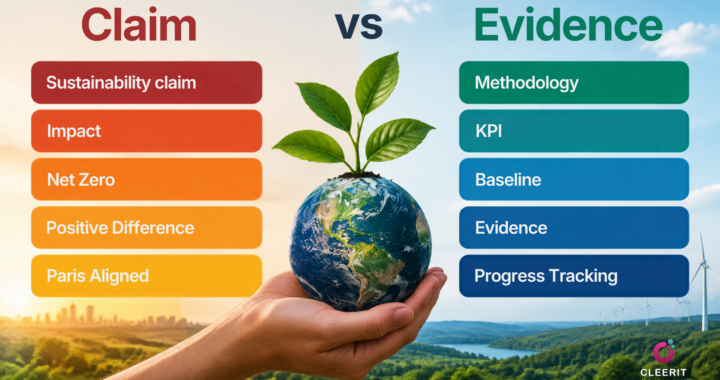
Sustainability claims increasingly influence investor decisions, customer trust and corporate reputation. At the same time, regulators are paying closer attention to the risk of greenwashing.
To support companies, ESMA, the EU’s financial markets regulator and supervisor, has recently published two new thematic notes offering practical advice on how to reduce the risk of greenwashing by ensuring non-regulatory sustainability communications are clear, fair and not misleading.
ESMA notes that sustainability claims may be misinterpreted and may mislead investors, even where this is not the intention of the company.
Key Takeaways
- Show, don’t just claim impact
- Support impact and transition claims with evidence
- Explain assumptions, limitations and methodologies
- Distinguish between outputs, outcomes and impact
- Connect transition ambitions to implementation plans and measurable progress
- Ensure consistency across all sustainability communications
- Use ESRS-based reporting as the foundation for transparent, traceable and defensible sustainability claims
Impact claims
ESMA’s thematic note on impact claims is a practical warning against using “impact” language unless companies can clearly explain and evidence how that impact is created.
The note stresses that claims about creating positive environmental or social outcomes must be accurate, accessible, substantiated and up to date.
Companies should avoid vague statements such as “making a positive difference” or “delivering impact” unless they can articulate a clear impact objective, a credible theory of change, and measurable indicators showing progress.
Communications should clearly distinguish between
- what the company or product intends to achieve (intentionality),
- why its actions make a difference beyond what would have happened anyway (additionality), and
- how outcomes are measured (measurability).
Cherry-picking data, relying on broad sustainability aspirations (e.g., SDG alignment alone), using impact terminology without evidence, or omitting limitations and assumptions are highlighted as common greenwashing risks.
The practical message is: show, don’t just claim.
If you communicate impact, explain the specific environmental or social problem being addressed, how your activities contribute to solving it, the criteria used to assess impact, and the KPIs used to monitor results.
Be transparent about whether metrics measure
- outputs (activities undertaken),
- outcomes (changes achieved), or
- actual impact (real-world benefits).
Disclose key assumptions, data limitations and methodologies.
Avoid taking credit for outcomes that cannot reasonably be attributed to the company’s actions.
Ensure that all marketing, sustainability reports and other communications are consistent with one another.
Climate transition claims
ESMA’s thematic note on transition claims focuses on how to communicate climate transition ambitions without creating greenwashing risk.
The key message is that transition claims are inherently forward-looking and subject to uncertainty, as their achievement may depend on future actions, assumptions and external factors.
They therefore require a higher level of transparency than claims about current sustainability performance.
Don’t treat transition claims as a marketing narrative about future intentions.
The note highlights the importance of clearly communicating what the transition ambition is, how it is expected to be implemented and how progress will be assessed and communicated, including relevant assumptions, data limitations and dependencies.
Companies should clearly explain three elements:
- the transition ambition (what is being achieved and by when),
- the implementation strategy (how the ambition will be delivered), and
- progress achieved (whether the company remains on track).
Any targets should include a baseline year, metrics, intermediate milestones and underlying assumptions, while references to net-zero, decarbonisation pathways, Paris alignment or science-based targets should be accompanied by explanations of what those concepts mean in the company’s specific context.
Broad aspirational statements without measurable objectives, methodologies or evidence are identified as a key greenwashing risk.
The practical recommendation is straightforward: every transition claim should be supported by evidence.
Explain how investments, projects, products or operational changes contribute to the stated transition objective, and disclose any material assumptions, dependencies and uncertainties.
Be transparent about exposure to high-emitting activities, the role of climate targets and transition plans, and the methodologies used to measure progress.
Report regularly against previously disclosed targets, use consistent metrics over time, disclose setbacks and explain changes in methodology instead of highlighting only positive developments.
Using ESRS as the foundation for transparent and defensible sustainability claims
ESMA’s guidance reinforces a trend that is becoming increasingly clear: sustainability communications can no longer be separated from sustainability reporting.
The requirements identified by ESMA closely mirror many of the principles embedded in ESRS reporting, including traceability, transparency, consistency and the use of measurable metrics and targets.
Companies that build their communications on robust ESRS data, transparent methodologies and documented evidence will be better positioned to avoid greenwashing risk and build trust with investors, customers and regulators.
Solutions such as Cleerit help organisations operationalise these requirements through
- structured governance,
- datapoint-level traceability,
- audit-ready documentation and
- clear linkages between impacts, policies, actions, targets and metrics,
creating a reliable foundation for credible sustainability claims.
Ultimately, the most effective defence against greenwashing is not better wording but better evidence. Companies that can clearly demonstrate how sustainability claims are supported by data, methodologies and measurable results will be best positioned to build trust with investors, customers and regulators.
Download ESMA’s thematic notes on positive impact and climate transition:
https://www.esma.europa.eu/press-news/esma-news/esma-promotes-clarity-claims-impact-and-transition