EU’s ESG Ratings Regulation (EU 2024/3005) came into effect on 2 July
In short:
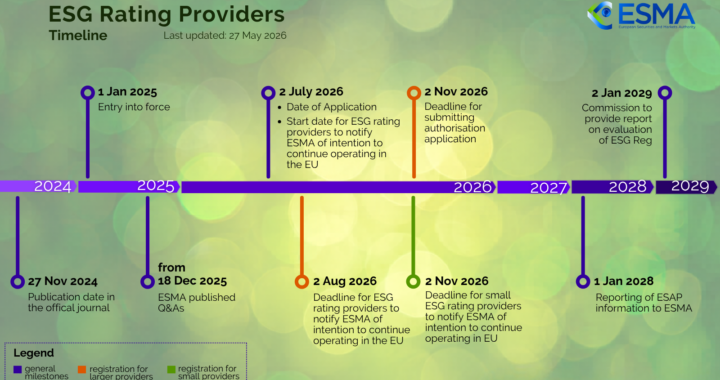
EU’s new ESG Ratings Regulation introduces mandatory ESMA supervision of all ESG rating providers from 2 July 2026. The goal is to fix long‑standing issues of opacity, inconsistency and low reliability in ESG ratings that companies use in CSR, sustainability and investor communication. During the transition period (July–November 2026), companies may reference ESG ratings only if the provider has notified ESMA. From 2 November 2026, ratings may be used exclusively from providers that appear in ESMA’s Article 14 public register.
This creates new compliance checkpoints for companies:
Before publishing annual reports, sustainability webpages or investor presentations, companies will need to verify the regulatory status of any ESG rating provider to ensure that referenced ratings come from transparent, supervised and trustworthy sources.
It also raises expectations for ESRS reporting quality.
ESRS sustainability statements must be complete, traceable and audit‑ready, as ESG rating providers will increasingly cross‑check ESRS disclosures with their own supervised methodologies. Strong governance around sustainability data is essential – documenting sources, reinforcing controls and clarifying responsibilities.
At the same time, investors and assurance providers will apply greater scrutiny to data quality, methodological alignment and consistency between ESRS disclosures and any ESG ratings referenced.
Cleerit’s guided digital ESRS end‑to‑end templates and governance processes help organisations get a head start, avoid wasted effort and build the robust, well‑structured sustainability statements required under this new regulatory landscape.
What the ESGR Regulation mean for you
If you use ESG ratings in your communication, it is essential to understand that the ESG Ratings Regulation (EU 2024/3005) places all ESG rating providers under direct ESMA supervision to enhance transparency, integrity and comparability, and to reduce greenwashing risks. From 2 November 2026, companies may only reference ESG ratings from providers that have submitted their application or notification and appear in ESMA’s Article 14 public register.
ESMA will maintain this public register on its website, along with a transitional list (July–November 2026) of providers that have notified ESMA of their intention to apply. To avoid market disruption, ESMA confirms that third parties may continue publishing or distributing ESG ratings from notified providers between 2 July and ESMA’s decision on their application. This temporary list will be updated regularly until the full register goes live.
From 2 November 2026 onward, only ESG ratings from providers that have applied and are listed in the Article 14 register may be published or distributed. This ensures continuity for financial market participants while the new supervisory framework is phased in.
For CSRD/ESRS‑aligned communication, companies should integrate a provider‑status check into their publication workflow – especially for annual reports, sustainability webpages and investor presentations.
Why this regulation came to be
The ESGR Regulation was introduced because the ESG ratings market had grown rapidly and become highly influential, yet operated without EU‑level rules. The Commission identified persistent issues: low reliability and timeliness, opaque methodologies, unsolicited ratings, and a lack of oversight – all of which created risks for investors and rated companies.
ESMA supervision aims to make ESG ratings clearer, more consistent and more trustworthy, while supporting the EU’s broader sustainable‑finance architecture (Green Taxonomy, SFDR, CSRD).
What problems does it aim to resolve?
- Low reliability, accuracy, and timeliness of ratings
Investors and companies observed that ESG ratings often differed widely, were based on outdated data, or lacked clear justification.
- Lack of transparency in methodologies and data sources
Providers used very different approaches, often without disclosing how ratings were constructed or what data they relied on. This made ratings hard to interpret or compare.
- Unsolicited ratings and unclear provider practices
Companies were sometimes rated without engagement or visibility into the process, creating confusion and reputational risks.
- No oversight or control of rating providers
Before this regulation, ESG rating providers were not subject to EU rules on governance, conflicts of interest, or operational integrity.
- Consequences for markets and investors
These issues undermined investor confidence in sustainable products and created risks of misallocation of capital.
The EU’s objectives are clear:
- Improve trust in ESG ratings and sustainable finance.
- Ensure fair and transparent rating practices for companies.
- Support the EU’s broader sustainable finance architecture (Green Taxonomy, SFDR, CSRD).
- Create a level playing field for rating providers operating in the EU.
How the ESGR Regulation connects to ESRS and CSRD reporting
The link to ESRS is direct: ESRS disclosures feed ESG ratings, and ESG ratings shape how ESRS information is interpreted externally.
The ESGR Regulation governs how ESG ratings are produced and supervised, while ESRS governs how companies disclose their own sustainability information.
The ESGR Regulation aims to ensure ratings are “independent, impartial, systematic and of adequate quality”.
Rating providers must now disclose:
- which E, S, G factors they use,
- how they weight them,
- what data limitations exist,
- whether they assess financial materiality, impact materiality, or both.
Companies should expect their ESRS disclosures to be evaluated against these methodological choices, meaning that ESRS disclosures will be scrutinised more systematically and weaknesses will be reflected in ratings.
This creates new expectations for accuracy, traceability, and communication discipline. ESRS disclosures must be reliable because ESG ratings will become more reliable.
For companies, this raises the bar for ESRS reporting quality.
Your ESRS sustainability statement must be well structured, complete, traceable and audit‑ready, as rating providers will rely more heavily on ESRS disclosures – and will be supervised by ESMA.
Strong governance around sustainability data is essential – documenting sources, reinforcing controls and clarifying responsibilities.
Investors and assurance providers will also apply greater scrutiny to data quality, methodological alignment and consistency between ESRS disclosures and any ESG ratings referenced.
New criteria to stop companies from making misleading sustainability claims including through ESG Credentials
In parallel, the European Union is also targeting greenwashing and forcing companies to prove their environmental impact in other ways. The Empowering Consumers for the Green Transition Directive (ECGT) will become fully enforceable on September 27, 2026, banning generic claims like “eco-friendly” or “green” without proof (https://eur-lex.europa.eu/eli/dir/2024/825/oj/eng).
ESMA has also recently published two thematic notes on clear, fair & not misleading sustainability-related claims, addressing greenwashing risks in support of sustainable investments (see one of the notes enclosed). They specifically targeted ESG Credentials:
- References to ESG credentials are among the most prominently used claims in retail-investor focused communications. These include references to qualifications, labels, ratings, certificates (henceforth referred to as “ESG credentials”): and can be misleading in several ways. For instance, by overstating the significance of having a given label, of receiving an ESG award, of being signatory to a voluntary framework, etc.
- Notably, these claims are of relevance for the following parties: fund managers (claims about funds’ and asset managers’ credentials), benchmark administrators (benchmarks’ credentials), investment service providers (claims at entity and/or product level) and issuers (entity-level claims).
- The ESG credential claim types below are considered in particular:
- a) Industry initiatives: actual significance of market participants’ involvement in net zero alliances, in voluntary ESG initiatives, including doing voluntary ESG reporting under specific international frameworks. Sometimes, being a signatory to some of these initiatives leads to receiving an external ESG rating/assessment from the third party, which may be based on self-reported ESG information.
- b) Labels and awards: actual significance of having a given credential like a national or regional label or perceived labels or of having won any type of ESG award (such as sustainability reporting awards for issuers); and
- c) Comparisons to peers: actual significance of ESG credentials that are based on comparing ESG characteristics of a product or an entity (including ESG metrics like carbon footprint, ESG ratings, etc.) to competitors, peer groups, etc. Very often, it is not clear whether a credential is absolute or whether it is based on a comparison to peers.
How to prepare
A well‑structured, machine‑readable ESRS statement not only ensures ESG rating readiness – it strengthens governance, accelerates internal learning, reveals strategic blind spots and positions your organisation for the EU’s dual green and digital transition.
If your first ESRS report is due for FY2027, remember: early reporters will already be on their fourth cycle. Building processes, collecting data, and aligning teams takes time. Waiting until 2027 means falling years behind, so starting now is essential.
👉 Cleerit’s guided digital ESRS end‑to‑end templates and governance processes help you get a head start by saving time, avoiding wasted effort and ensuring a higher‑quality, more trustworthy sustainability statement. Contact us here >>>
Sources:
Regulation (EU) 2024/3005 on the transparency and integrity of Environmental, Social and Governance (ESG) rating activities: https://eur-lex.europa.eu/eli/reg/2024/3005/oj/eng
ESMA rules for ESG rating providers: https://www.esma.europa.eu/esmas-activities/investors-and-issuers/esg-rating-providers
Public Statement from ESMA on what third parties may legally do with ESG ratings during the transition to the new EU ESG Ratings Regulation: https://www.esma.europa.eu/sites/default/files/2026-07/ESMA84-1427279869-1396_Public_Statement_on_Publication_or_distribution_of_ESG_ratings_by_third_parties_in_the_period_from_2_July_2026_until_authorisation__recogniti.pdf
ESMA’s thematic notes on clear, fair & not misleading sustainability-related claims addressing greenwashing risks in support of sustainable investments : ESMA36-429234738_-154_Thematic_notes_on_clear__fair___not_misleading_sustainability-related_claims.pdf