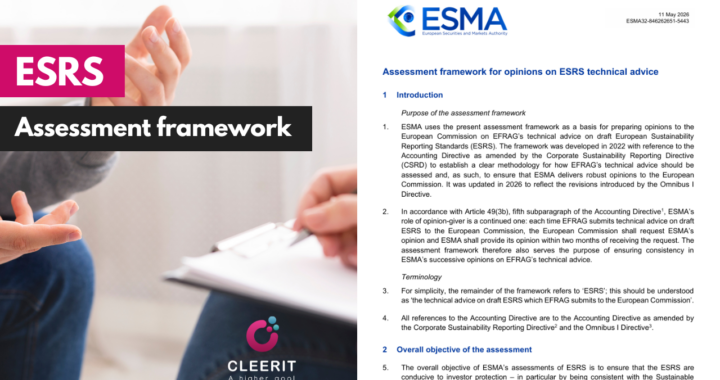
ESMA has just published its new Assessment Framework (11 May), and it’s an important milestone for the future of ESRS.
Unlike the February Opinion on the revised ESRS, this Framework is not a legal deliverable – it’s an internal supervisory tool designed to bring clarity, consistency, and transparency to how ESMA evaluates EFRAG’s technical advice.
The Framework provides a stable methodology that ESMA will use for all future ESRS assessments. It reflects the lessons learned from the February Opinion and ESMA’s core mandate:
▪️ High‑quality, decision‑useful sustainability information
▪️ Investor protection
▪️ Financial stability
▪️ Coherence with EU sustainable finance rules
ESMA evaluates ESRS across four criteria, each with detailed sub‑criteria and indicators, rated from fully capable to not capable:
1️⃣ Quality of sustainability information
Are disclosures forward‑looking, risk‑based, comparable, entity‑specific, and aligned with the Accounting Directive?
2️⃣ Consistent application
Are the standards clear, auditable, enforceable, and compatible with ESEF digital tagging?
3️⃣ Consistency with EU legislation
Do ESRS align with SFDR PAI indicators, Taxonomy Article 8, CTB/PAB benchmarks, and other EU rules?
4️⃣ Interoperability with global standards
How well do ESRS align with IFRS S1/S2 and GRI, while preserving EU‑specific concepts like double materiality?
ESMA may update the Framework as legislation evolves – but it now provides a transparent reference point for future ESRS evaluations.
How this differs from the February Opinion
ESMA’s Opinion on the revised ESRS (Feb) was not a methodology – it was a concrete assessment of EFRAG’s December 2025 draft standards.
ESMA welcomed simplification but flagged some issues affecting investor protection and comparability, including:
- Reliefs: Too broad or permanent, reducing data quality and weakening alignment with IFRS S1/S2.
- Materiality: Need for clearer guidance on top‑down assessments and treatment of non‑material subsidiaries.
- Climate & transition plans: Requests for clearer definitions, ambition levels, and stronger requirements on targets and financed emissions.
- SFDR & Taxonomy alignment: Risks of burden‑shifting and loss of key datapoints.
- Digital reporting: Some grouped disclosures still need separate tagging.
- Interoperability: Divergences in scenario analysis, GHG boundaries, and reliefs absent from IFRS.
In short
- The February Opinion = ESMA’s judgement on the revised ESRS.
- The May Assessment Framework = the methodology ESMA will use going forward.
Together, they signal a clear direction: simplification is welcome, but not at the expense of investor‑grade sustainability information – meaning sustainability data that is as trustworthy, comparable, and decision‑useful as financial information.
👉 Contact us if you want to use our guided digital ESRS end-to-end templates to get a head start >>>
The Assessment Framework is available here: https://www.esma.europa.eu/sites/default/files/2026-05/ESMA32-846262651-5443_ESRS_assessment_framework.pdf