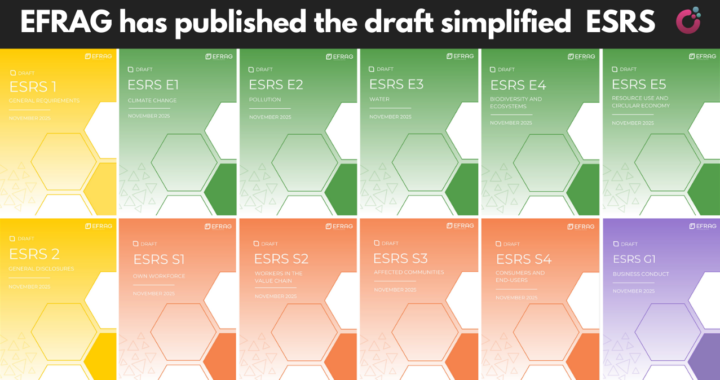
EFRAG has today, 3/12, submitted its technical advice to the European Commission on the draft simplified European Sustainability Reporting Standards (ESRS), with the objective of fostering greater competitiveness by easing the regulatory landscape without compromising the fundamental objective of the Green Deal to advance sustainability in the European Union.
Using the Amended ESRS, undertakings will be able to better integrate sustainability in their communication to the market, beyond compliance.
The purpose of the streamlined DMA and of the explicit emphasis on fair presentation is to encourage undertakings to focus on what really matters and to avoid unnecessary granular information often associated with a compliance exercise. In doing so the level of alignment with IFRS S1 is further enhanced.
EFRAG received more than 700 responses to its public consultation which, combined with 21 outreach events carried out in the course of September and 2 targeted field tests, provided invaluable input to EFRAG’s due process.
EFRAG notes that the legislative process referred to as Omnibus initiative is not completed. Should the conclusion of the legislative process affect in any way the substance of this technical advice, EFRAG stands ready to adapt the Amended ESRS if required to do so.
While the simplification efforts were broadly supported, some critical remarks were also noted, which mainly relate to the accumulation of reliefs without time limits, and more generally to the fact that reliefs should be the exception, not the norm and that this should be explicit in the standards to avoid creating blind spots in reporting and thus hindering appropriate risk management.
The objective of an ESRS sustainability statement
The Amended ESRS state that the objective of an ESRS sustainability statement, taken as whole, is to present fairly all the undertaking’s
- sustainability-related material impacts, risks and/or opportunities (IROs)
- and how the undertaking manages them,
- organised under topics to which they relate.
The presentation of IROs
The presentation of IROs is now divided into 2 different disclosure requirements in ESRS 2: IRO-2 and SBM-3.
The objective of disclosure requirement IRO-2 is to enable an understanding of the outcome of the materiality assessment, in terms of material IROs and material information reported in accordance with ESRS.
The objective of disclosure requirement SBM-3 is to enable an understanding of the interactions between the undertaking’s material impacts, risks and opportunities and its strategy and business model, as well as of the related financial effects.
Disclosure requirement IRO-2
IRO-2, paragraph 37(a), focuses on a description of impacts, risks and opportunities and how they are likely to affect people and the environment.
The undertaking shall disclose
- a concise description of its actual and potential, positive and negative material impacts,
- including how they affect or are likely to affect people or the environment, and its material risks and opportunities,
- specifying the related topics and
- how and where impacts, risks and opportunities are connected to its own operations and its upstream and downstream value chain,
- the description of material risks and opportunities also covers the related dependencies to the extent that is necessary for an understanding of those risks and opportunities.
The undertaking may present the descriptions of its material IROs in the same location as its disclosures on the related policies, actions, metrics and targets through which it manages them, in order to avoid duplication and support a coherent narrative.
If the undertaking exercises this option, it shall still present a concise description of its material IROs alongside its disclosures prepared in accordance with IRO-2.
Disclosure requirement SBM-3
SBM-3 focuses on reporting the interaction of the undertaking’s material impacts, risks and opportunities with its strategy and business model.
The undertaking shall disclose
- a high-level description of how material impacts originate from its strategy and business model,
- the effects of risks and opportunities on its business model and value chain,
- how it has responded, and plans to respond, to them in its strategy and decision-making
- qualitative and quantitative information about how material risks and opportunities have affected its financial position, financial performance and cash flows for the reporting period (current financial effects)
- qualitative and quantitative information on how it expects its financial position, financial performance, and cash flows to change over the short, medium and long term, given its strategy to manage material risks and opportunities (anticipated financial effects)
- qualitative information about the resilience of its strategy and business model regarding its capacity to manage its material risks, including how the analysis was conducted and the time horizons considered.
Current financial effects and anticipated financial effects of material risks and opportunities
Current financial effects and anticipated financial effects are designed to produce information that complements information provided in the financial statements.
Current financial effects are financial effects for the current reporting period that are recognised in the primary financial statements.
Anticipated financial effects are financial effects that do not meet the recognition criteria for inclusion in the financial statement line items in the reporting period and that are not captured by the current financial effects.
In presenting information about current financial effects and anticipated financial effects, the undertaking may consider the linkage with the information reported in accordance with GDR-A about financial resources allocated to the key actions.
‘Wave-one’ undertakings (=those that were scheduled by the CSRD to report on sustainability for the first time for financial year 2024) may omit quantitative information about anticipated financial effects for their financial years prior to financial year 2030.
The undertaking need not provide quantitative information about the current financial effects or anticipated financial effects if it determines that:
- the effects are not separately identifiable; or
- the level of measurement uncertainty involved in estimating those effects is so high that the resulting quantitative information would not be useful.
The undertaking need not provide quantitative information about the anticipated financial effects of material risks or opportunities if it does not have the skills, capabilities or resources to provide that quantitative information.
If the undertaking cannot provide quantitative information about the current financial effects or anticipated financial effects of a risk or opportunity it shall:
- explain why it has not provided quantitative information;
- provide qualitative information about those financial effects;
- provide quantitative information about the combined financial effects of that risk or opportunity with other risks or opportunities and other factors, unless the undertaking determines that quantitative information about the combined financial effects would not be useful.
If the undertaking cannot provide quantitative information, it is expected to provide qualitative information that is decision useful (including for decisions relating to providing resources to the undertaking).
Managing material IROs with policies, actions, metrics and targets
Information about policies, actions, metrics and targets shall enable an understanding of the level at which the undertaking manages its material IROs.
Policies and actions describe how the undertaking
- manages the prevention, mitigation and remediation of actual and potential material negative impacts, as well as material risks or
- pursues actual and potential material positive impacts and material opportunities.
Metrics and targets describe the assessed progress over time in relation to its material IROs.
The General Disclosure Requirement for policies – GDR-P includes a description of the key contents of the policy, including its general objectives and the material IROs it relates to.
General Disclosure Requirement for actions and resources – GDR-A covers key actions that play a significant role in managing the undertaking’s material IROs including actions taken to support the provision of remedy.
It includes a description of the key actions taken in the reporting year and those planned for the future, including their scope and timeframe and their expected outcomes and, where applicable, how their implementation contributes to achieving the related policy objectives.
It also includes the type and amount of current and future significant financial resources allocated to the key actions.
If the undertaking has allocated significant non-financial resources (e.g. full-time equivalent resources), the information about those resources may be presented as non-monterary quantities.
General Disclosure Requirement for targets – GDR-T includes measurable, time-bound, outcome-oriented qualitative or quantitative targets the undertaking has set related to its material IROs, including description of the relationship of the target to its policy objectives and actions.
They describe how the undertaking tracks the effectiveness of its policies and actions in relation to its material IROs, as well as the overall progress and effectiveness towards the adopted targets over time.
When reporting on policies, actions, metrics and targets, the undertaking shall report relevant information, avoiding information that is boilerplate, and therefore not relevant for users.
Excessive detail, especially about common practices, which are known to reasonably knowledgeable users, may obscure material information
If the undertaking has adopted policies, put in place actions, set targets or uses metrics only for certain aspects of a topic, this shall be reflected in the way the disclosure is prepared and presented, enabling users to understand the specific aspects that are covered.
If the undertaking has not adopted policies, actions, and targets with reference to a topic related to material impacts, risks and opportunities, it shall disclose this fact.
Presentation of sustainability information
Sustainability information shall be presented:
- in a way that allows for clear identification of information required by ESRS from other information included in the management report; and
- under a structure that facilitates access to and understanding of the sustainability statement in a format that is both human-readable and machine-readable.
ESRS do not mandate behaviour except for behaviour specifically related to the reporting of sustainability information.
The draft simplified European Sustainability Reporting Standards (ESRS) are available here:
Next step
The European Commission will now prepare the Delegated Act revising the first set of ESRS based on EFRAG’s technical advice (expected mid-2026).